EU AI Act and AI Competence (AI Literacy)
What businesses need to know
The EU AI Act is frequently cited as the basis for mandatory AI training. But does the regulation actually prescribe training programmes? What does it specifically require regarding AI competence – and what obligations arise for businesses?
The following information provides a factual assessment of the regulation.
EU AI Act – Ensuring AI Competence
The key provision on "AI competence" (AI Literacy) is Article 4 of the regulation. It states:
"Providers and deployers of AI systems shall take measures to ensure, to their best extent, a sufficient level of AI literacy of their staff and other persons dealing with the operation and use of AI systems on their behalf, taking into account their technical knowledge, experience, education and training and the context the AI systems are to be used in, and considering the persons or groups of persons on whom the AI systems are to be used."
(Article 4 EU AI Act)
What does this mean in practice?
Who is affected?
Article 4 applies to providers and deployers of AI systems.
- Providers develop or market AI systems.
- Deployers use AI systems within their own organisation.
The term "deployer" can be slightly misleading. It refers to any organisation that uses AI. This means: any company that employs AI applications in its day-to-day operations – regardless of whether these were developed in-house or procured externally – falls under this provision.
The obligation covers both the company's own employees and external personnel working with AI on behalf of the organisation.
How must AI competence be ensured?
Companies must take appropriate measures to ensure a sufficient level of AI competence.
However, the regulation does not prescribe specific training formats, certificates, or minimum hours. The choice of implementation is at the company's discretion. The benchmark is appropriateness within the respective business context.
What standard applies?
The EU AI Act follows a risk-based approach. This means there is no uniform training standard for everyone. The determining factors include:
- Knowledge and experience of the individuals concerned,
- Role and area of responsibility,
- Type of AI system deployed,
- Context of use and potential impact on affected persons.
The higher the potential impact of an application, the greater the requirements for competence and organisational safeguards.
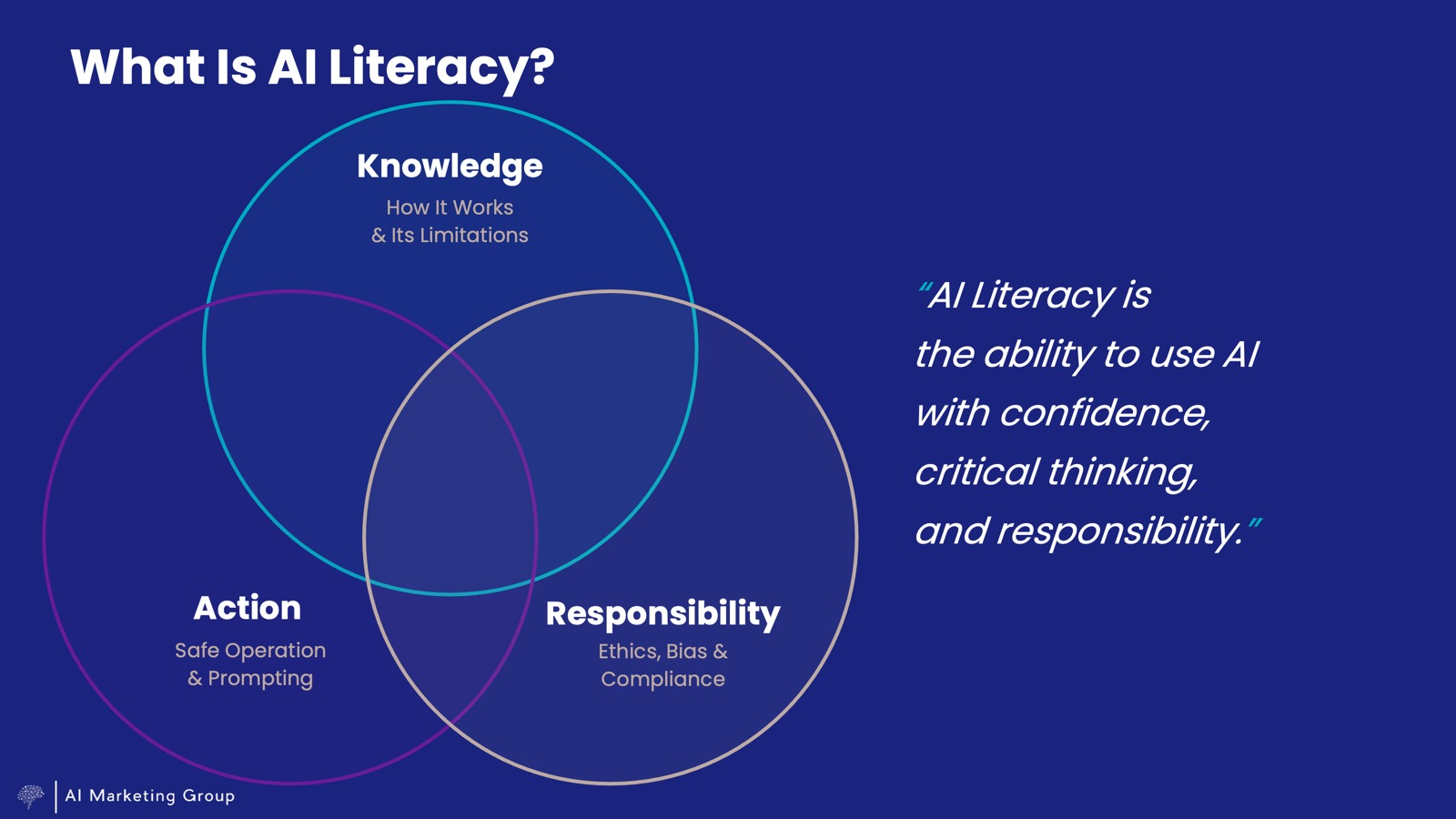
What does "AI Literacy" mean?
The definition is found in Article 3(56):
"'AI literacy' means skills, knowledge and understanding that allow providers, deployers and affected persons, taking into account their respective rights and obligations in the context of this Regulation, to make an informed deployment of AI systems and to gain awareness of the opportunities and risks of AI and possible harm it can cause."
AI literacy therefore encompasses:
- Knowledge of how AI systems work and their limitations,
- the ability to use AI systems appropriately,
- an awareness of risks and potential harm,
- as well as an understanding of the legal and organisational framework.
Applicability, enforcement, and consequences
1 August 2024
EU AI Act entered into force
2 February 2025
AI competence obligation applies
2 August 2026
Full application of the EU AI Act
Compliance is monitored by national market surveillance authorities. Where personal data is processed, data protection supervisory authorities are also responsible.
The EU AI Act provides for fines in the event of infringements. The amount depends on the nature and severity of the respective violation.
There is no standalone "training obligation penalty" for Article 4. What matters is whether a company has taken appropriate organisational measures.
In the event of an incident – for example, a discriminatory decision or a data protection breach – it will be assessed whether:
- risks were assessed,
- internal guidelines were in place,
- employees were adequately qualified,
- responsibilities were clearly defined.
If such measures are lacking, this can be regarded as a violation of the regulation.
In practice, Article 4 therefore becomes particularly relevant in connection with specific incidents.
Further information
EU AI Act – Full text
Regulation (EU) 2024/1689, Official Journal of the European Union
Read full textUsing AI Safely & EU AI Act
Our masterclass for practical implementation – for employees and leaders.
To the masterclassBuild AI competence in your organisation?
Our training programmes help you meet the requirements of the EU AI Act in a practical way.
View our training programmes →